Taekwondo Strength Training
It may seem that Taekwondo doesn’t require much strength. With fast foot movement and unrivalled leg dexterity, it is often thought that strength training would make you slower for Taekwondo.
Strength training for Taekwondo should focus on developing robustness in the lower body due to the large number of injuries. Further, the ability to produce force in multiple directions very quickly is a key indicator of an elite Taekwondo athlete.
Before diving deep into a strength training program for Taekwondo, we must identify the common injuries associated with Taekwondo and what differentiates elite from non-elite practitioners.
Injury Profile Of Taekwondo
Injuries in the lower body seem to be most prevalent in International and National level Taekwondo athletes [1][2]. In the study of the 1997 Canadian National Championships, face and spine injuries were the next most prevalent [1].
These consisted mainly of sprains, bruises, cuts, strains, and joint dysfunctions. Concussions were next in line.
The mechanism of injury mainly occurred by receiving a kick or delivering a kick to the elbow or landing a kick with the toes.
It should be noted that these injuries to the feet and lower body were at a time before protective equipment was introduced.
In Spanish National Taekwondo athletes, similar injury types were found with most injuries occurring in the lightest weight classes [2].
The majority of these injuries occurred in training sessions (61%).
Alarmingly, the incidence of concussion in Taekwondo athletes is up to four times higher than American Football [3].
This is not surprising considering the clench axe kick results in greater linear acceleration of the head exceeding an uppercut in boxing.
How does this affect success in Taekwondo competition? Winners sustained significantly less injuries than non-winners and for every additional injury per match, competitors were 88% less likely to win a medal [4].
It is understandable that lower body injuries are the most common in Taekwondo being a combat sport that emphasizes lower body techniques.
The research suggests that developing lower body robustness and neck strength may help with reducing the risk and severity of injury.
Elite vs. Non-Elite Taekwondo Athletes
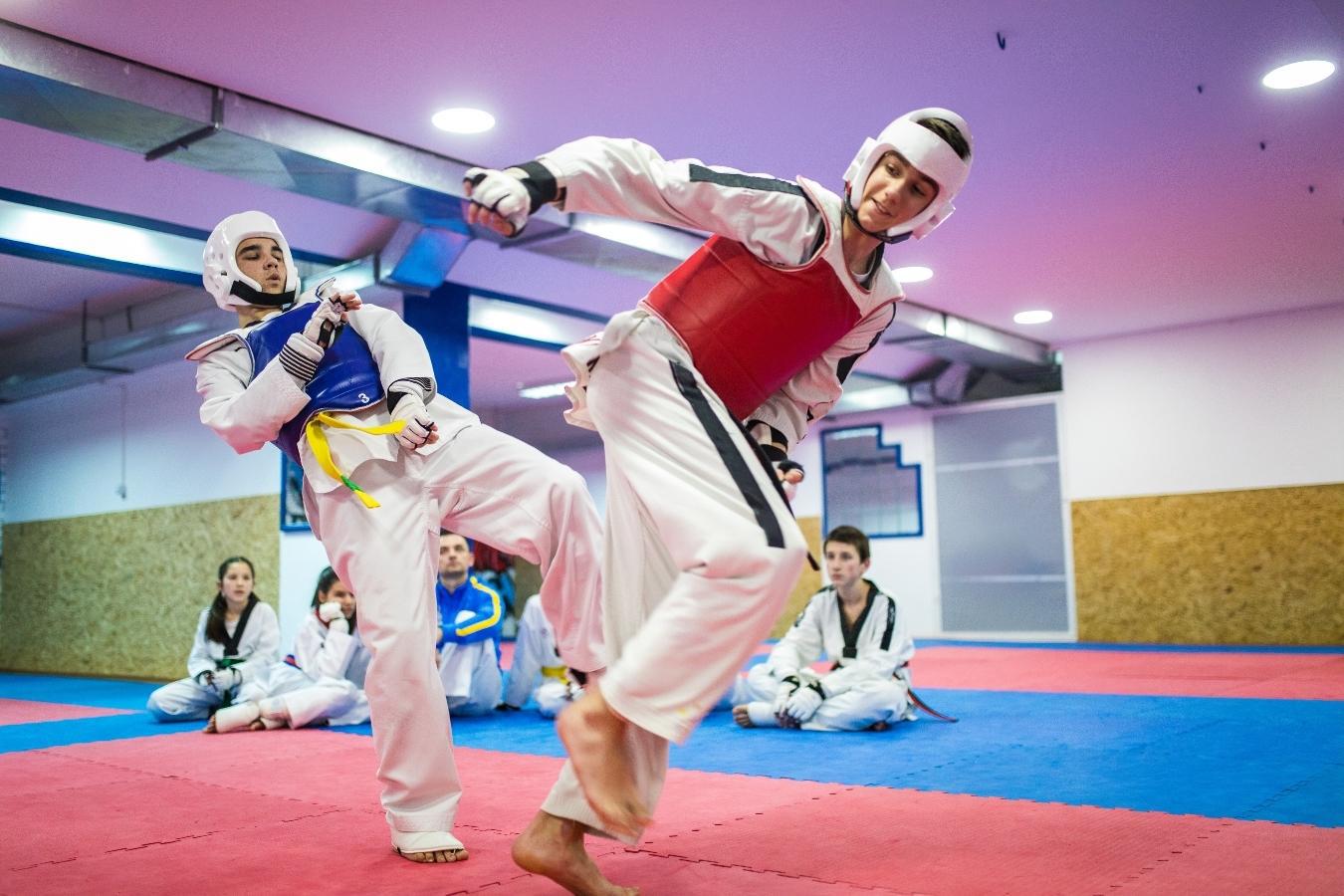
When we compare elite level Taekwondo athletes with non-elite, we can determine what the most important and influential qualities are to the sport.
Within the Belgian National Team, athletes were split into elite and non-elite groups [5]. Elite athletes were those that had represented Belgium at International Championships or Olympic Games and/or had won a medal at an international tournament.
Non-elite athletes were those that were not in the squad, did not participate in these competitions, or did not win any medals at international competition.
Elite Taekwondo athletes in this cohort were slightly taller and 27% leaner than their non-elite counterparts.
They were also 4% faster over a 30 m sprint, jumped 15% higher, and had significantly better test scores for motor coordination consisting of sideways jumping and balancing on a beam which have been shown to differentiate between different skilled combat athletes [5].
The female Croatian National Team has also been investigated and were split into an elite group who had won a medal at either the Europeans, Worlds, or Olympic Games, and a non-elite group who had not won a medal at any of these competitions [6].
Similar results were found regarding body type where elite Taekwondo athletes were slightly taller and slightly leaner than the non-elite athletes.
While not all statistically significant, the elite athletes scored higher in every physical test (same findings as the Belgium National Team) compared to the non-elites.
Specifically, they were able to jump 12.5% higher, sprint 6% faster over 20 m, be 5% faster in the side step agility test, and were able to produce 18% more power over a 15 sec test.
The final study split black belt athletes into an elite group (finalists or semi-finalists in the National Championship including champions and International competitors) and a non-elite group (State competitors who didn’t qualify for Nationals) [7].
What was interesting about this study was the researchers didn’t measure traditional physical tests. Rather, they compared the performance of maximal Bandal Chagui kicks and were able to collect force and muscle activation data.
They found that elite athletes displayed greater reaction time to start to move the pelvis for the kick to a visual stimulus. Further, they needed less time in the preparation and kicking phase with less total kicking time than non-elites.
Elite athletes also displayed greater velocity of the hip, knee and foot during the kick. Additionally, they showed greater peak force in the side to side and back to front force vector and rate of force development (speed in which force is produced) compared to the non-elite athletes.
Peak vertical force was only just significantly higher than non-elite Taekwondo athletes. These findings of being able to display more force explosively ties in with the physical testing results from the previous two studies above showing superior jump and sprint performances.
This all suggests that being leaner and more powerful in the horizontal, lateral, and vertical direction positively influences Taekwondo performance.
Strength Training For Taekwondo

The main focus of this strength program for Taekwondo is to develop the ability to produce a lot of force quickly in multiple directions. In doing so, we also develop robustness in the lower body as strength training isn’t solely performed in the vertical direction.
Phase 1 will be our preparation phase. You can’t start the most intense training straight away as the stimulus can be so extreme you injure yourself and secondly, when we can make progress with less intense training, we can keep progressing.
This will consist of sub-maximal plyometrics, jumping, and lifting performed three times per week.
Phase 2 will progress to more intense variations of exercise using complexes with more specific exercise variations all performed twice per week.
It may not seem like a lot of work each session, but the goal is to develop the necessary qualities without severely impacting Taekwondo sessions.
Phase 1
Day 1
| Exercise | Set/Rep |
|---|---|
| Robustness Circuit | |
| A1) Single Leg Lateral Line Hop | 3x20 |
| A2) Sub-Maximal Squat Jump | 3x10 |
| A3) 4-Way Neck ISO | 3x10-20sec |
| Main Work | |
| B1) Bulgarian Split Squat | 3-4x6-8/leg |
| C1) DB Incline Bench | 3-4x6-8 |
| C2) Chin-Up | 3-4x5-10 |
| D1) Hip Thrust | 3-4x6-8 |
| E1) Lateral Oblique Hold | 3x20sec/side |
Day 2
| Exercise | Set/Rep |
|---|---|
| Robustness Circuit | |
| A1) Skipping | 3x1-2 min |
| A2) Copenhagen Plank | 3x20-30sec/side |
| A3) Lateral Neck Flexion | 3x15-20/side |
| A4) Extensive Rolling Hop | 3x10 |
| Main Work | |
| B1) Romanian Deadlift | 3-4x5-8 |
| C1) Heavy Lateral Sled Drag | 3x10-15m |
| D1) DB Press | 3-4x6-10 |
| D2) Inverted Row | 3-4x10-15 |
| E1) Ab Wheel | 3x10 |
Day 3
| Exercise | Set/Rep |
|---|---|
| Robustness Circuit | |
| A1) Single Leg Calf Raise | 3x10-20 |
| A2) Sub-Maximal Skater Jump | 3x10 |
| A3) 4-Way Neck ISO | 3x10-20sec |
| A4) Pallof Press | 3x10/side |
| Main Work | |
| B1) Heavy Sled Drag | 3-4x20m |
| C1) Push-Up | 3-4x8-15 |
| C2) Chest Supported Row | 3-4x8-15 |
| D1) Lateral Lunge | 3x6-10/side |
Phase 2
Day 1
| Exercise | Set/Rep |
|---|---|
| A1) Hip Thrust | 3x6-8/leg |
| A2) Bounding LLRR | 3x2-3LLRR |
| B1) Lateral Sled Sprint | 3x10-15m |
| B2) Drop Skater Jump | 3x5/side |
| C1) DB Incline Bench | 3x6 |
| C2) Med Ball ‘Punch’ Throw | 3x5/side |
| D1) Lateral Oblique Hold w/ Pulse | 3x10sec/side |
| D2) Reactive Neck ISO | 3x10-15sec |
Day 2
| Exercise | Set/Rep |
|---|---|
| A1) KB Swing | 3x6-10 |
| A2) Broad Jump Bound | 3x3-5 |
| B1) Landmine Rotation | 3x5-6/side |
| B2) Explosive Rotational Med Ball Throw | 3x5/side |
| C1) Chin-Up | 3x5-10 |
| D1) Neck Protraction/Retraction | 3x10 |
| D2) Band Face Pull | 3x15-20 |
References
1. Kazemi, M., & Pieter, W. (2004). Injuries at a Canadian National Taekwondo Championships: a prospective study. BMC musculoskeletal disorders, 5(1), 1-8.
2. Altarriba-Bartes, A., Drobnic, F., Til, L., Malliaropoulos, N., Montoro, J. B., & Irurtia, A. (2014). Epidemiology of injuries in elite taekwondo athletes: two Olympic periods cross-sectional retrospective study. BMJ open, 4(2), e004605.
3. Pieter, W., Fife, G. P., & O'Sullivan, D. M. (2012). Competition injuries in taekwondo: a literature review and suggestions for prevention and surveillance. British journal of sports medicine, 46(7), 485-491.
4. Kazemi, M. (2012). Relationships between injury and success in elite Taekwondo athletes. Journal of sports sciences, 30(3), 277-283.
5. Norjali Wazir, M. R. W., Van Hiel, M., Mostaert, M., Deconinck, F. J., Pion, J., & Lenoir, M. (2019). Identification of elite performance characteristics in a small sample of taekwondo athletes. PloS one, 14(5), e0217358.
6. Marković, G., Mišigoj-Duraković, M., & Trninić, S. (2005). Fitness profile of elite Croatian female taekwondo athletes. Collegium antropologicum, 29(1), 93-99.
7. Moreira, P. V. S., Goethel, M. F., & Gonçalves, M. (2016). Neuromuscular performance of Bandal Chagui: Comparison of subelite and elite taekwondo athletes. Journal of Electromyography and Kinesiology, 30, 55-65.
Taekwondo Conditioning
Taekwondo is mainly researched within the WTF governing body as it is the body in the Olympics. Matches are typically 3 x 2min rounds with 1 min separating each round. But this doesn’t tell us what we need to know regarding conditioning for taekwondo.
Taekwondo has large contributions from the aerobic and alactic energy systems which is due to the 1:7 high-intensity effort to pause ratio of competition. Further, the most elite taekwondo athletes are able to perform high-intensity techniques with greater speed and power.
Before diving into the specifics of conditioning for taekwondo, we must understand the demands of the sport and what differentiates the elite from the non-elite.
Physiological Profile of Elite vs. Non-Elite Taekwondo Athletes
A study took 13 female taekwondo athletes from the Croatian National Team and were divided into two groups [1]. Group A (elite) were athletes that had won one or more medals at the European or World Championships, or at the Olympics in the past five years.
Group B (non-elite) had not won a senior medal at any of these competitions. The elite group were able to reach higher speeds during a maximum fitness running test, and had a higher anaerobic threshold at lower heart rates compared to the non-elite group.
Maximum aerobic ability was not statistically different between the groups. However, there was a trend for the elite group to display greater aerobic power.
When profiling the anaerobic capacity of elite Taiwanese Taekwondo athletes, the two Olympic medalists that were part of the squad showed higher peak and mean power relative to bodyweight and a lower rate of fatigue compared to other squad members [2].
Another study split 64 elite Polish Taekwondo athletes into two groups [3]. The elite group had won medals at the Polish National Championships while the non-elite group had not. They found that the elite group displayed greater peak power than the non-elite.
Finally, 5 elite Italian Internaitonal Medalists (Europeans, Worlds, & Olympics) were compared to top 3 Nationally ranked Italian Taekwondo black belts [4].
They found blood lactate and rate of perceived exertion to be higher in the National level athletes compared to the International Medalists after a Taekwondo specific circuit indicating the ability of elite level Taekwondo athletes to tolerate heavy training.
A study of 4 Australian Taekwondo athletes 9 weeks before 2008 Olympic games showed an average estimated VO2max of 53 ml.min-1kg-1 during a running test which is a very similar aerobic profile to other martial arts such as Muay Thai, MMA, and Wrestling [5].
However, estimated VO2max tests can greatly underestimate true aerobic capability by 16% [6]. This seems to ring true when we look at direct measures of VO2max using the treadmill test in International level Taekwondo athletes.
15 elite Italian Taekwondo athletes had an average VO2max of 63 ml.min-1kg-1 which is on par with some elite level boxers and getting close to elite level endurance athletes [7] . Similar results were found in elite Puerto Rican Taekwondo athletes with VO2max values of 59 ml.min-1kg-1 [8].
If we compare these VO2max values with recreational taekwondo athletes, we see values ranging from 41-44 ml.min-1kg-1 indicating Taekwondo also requires a well-developed aerobic energy system [9][10].
It seems the ability to generate high levels of anaerobic power and the ability to sustain intense work is what differentiates elite and non-elite taekwondo athletes. A well-developed aerobic energy system is also synonymous with elite level taekwondo athletes which likely enhances recovery between intense bouts of activity.
Physiological Demands Of Taekwondo

10 male taekwondo black belts who were currently active in National and International competition were put through their paces in a simulated match under WTF rules for 3 x 2min rounds [11]. They measured heart rate, blood lactate, and VO2 during the match.
The authors found the aerobic energy system was the predominant energy system contributing 66% of the total energy of combat. The anaerobic alactic contributed 30% while the anaerobic lactic energy system contributed 4%.
The first round showed the greatest contribution from the anaerobic lactic energy system which decreased each round as the aerobic contribution became greater.
While simulated competition often doesn’t replicate real competition, the effort to pause ratio and number of technical actions were identical to previous research in World Championships and Olympic Games.
Interestingly, Croatian National female taekwondo athletes who had won medals at European or World Championships were monitored during their National Championships [12]. Heart rate was recorded throughout the matches and blood lactate after each round.
They observed very different energy system contributions suggesting the anaerobic lactic energy system was the primary energy source. This was estimated from the very high average heart rates that occurred each round and the high blood lactate levels (11.7 mmol.L-1) after the fight.
Interestingly, in British National taekwondo athletes competing in an International competition, close to maximum heart rates suggested large demands placed on the aerobic energy system [14].
When looking at the data of these two papers, the stark differences in results in my opinion potentially come down to the aerobic capabilities. The average VO2max for this group of Croatian females was 50 ml.min-1kg-1 whereas black belt athletes in the previous study would reach 53 ml.min-1kg-1 as an average for the third round.
Further, the effort to pause ratio was not presented in the Croatian female fights where a more active fight could have led to higher heart rates and more blood lactate accumulation.
A study in the Brazilian National Competition had similar findings with the first study where the alactic energy system predominantly supplied the high-intensity activity while the aerobic energy system contributed greatly to restore energy during pauses in the match [13].
Overall, it seems Taekwondo matches present very high cardiovascular strain that stresses all three energy systems to some degree. However, my interpretation of the research suggests that having a highly developed aerobic energy system allows the taekwondo athlete to throw high-intensity techniques without having to dip into anaerobic lactic energy reserves to such as great degree.
This seems to especially ring true with the activity profile of Taekwondo.
Activity Profile Of Taekwondo
A 2011 study analysed both World Champion and Olympic Games events to determine the activity profile of elite level taekwondo [15]. They found an effort to pause ratio of 1:7 which is the same as what was simulated in the black belt taekwondo athletes and Brazilian National competition [11][13].
This translates to approximately 1-5 seconds of high-intensity activity with 7-35 seconds of skipping or pausing [16].
What Differentiates Winners And Losers In Taekwondo
Interestingly, this effort to pause ratio seems to stay consistent regardless of winning or losing at the World Championship and Olympic Games level [15]. However, medalists at the Olympic Games spent more time skipping than non-medalists.
This has also been observed in the Brazilian National Competition where no heart rate or blood lactate variable distinguished between winners and losers but winners spent on average double the amount of time in phases between high-intensity movements [13].
It seems that the highest-level competitors are able to perform their techniques at much higher intensity than non-winners.
This has been backed up by research in Polish International medalists displaying greater speed than non-medalists [3].
Conditioning For Taekwondo
Based on the effort to pause ratio, the physiological demands of a match, and the physical profiles of elite level taekwondo athletes, a training schedule emphasizing the aerobic and alactic energy systems would make sense.
Alactic Power
Alactic power is generally developed with strength and power training in the gym. Various jumps, throws, and hops for sets of 2-6 with full recovery between sets.
This can also be developed throwing various powerful kicking combinations for 7-10 seconds with full recovery between sets which will range between 2-5 minutes but this cannot replace the strength and power in the gym. An example would be:
| Week | Exercise | Set/Rep | Rest |
|---|---|---|---|
| Week 1 | Bag Work | 5 x 7 sec | 2-3 min |
| Week 2 | OR | 7 x 7 sec | 2-3 min |
| Week 3 | Jumps/Throws | 9 x 7 sec | 2-3 min |
| Week 4 | 11 x 7 sec | 2-3 min |
Alactic Capacity
This is where your most specific taekwondo training will occur. Alactic capacity intervals sit right in the range of the 1:7 effort to pause ratio. Here we can develop the ability to sustain high-intensity efforts.
It’s important that you perform this type of conditioning (and almost all of your conditioning) as close to taekwondo as possible.
Recent research compared a repeated sprint training protocol (10 x 35m sprints with 10 sec rest) to a repeated high-intensity kicking technique protocol (10 x 6 sec Bandal-tchagui with 10 sec rest) [17].
Both groups similarly improved physical markers such as aerobic ability and power.
However, the kicking group performed a greater number of techniques with the non-dominant leg during the 10 second specific kicking test compared to the sprint group and posted a lower blood lactate value after a 1-minute kicking test.
Conditioning is more than just general physiology. You must be conditioned to perform the movements of your sport for it to have the best transfer. Here is an example of how you could use this using the guidelines of 10-12 x 10-15 seconds with 20-90 seconds rest.
| Week | Exercise | Set/Rep | Rest |
|---|---|---|---|
| Week 1 | Bag or Pad Work | 10 x 10 sec | 70 sec |
| Week 2 | 12 x 10 sec | 70 sec | |
| Week 3 | 2 x (10 x 10 sec) | 70 sec between reps, 6-8 min between sets | |
| Week 4 | 2 x (12 x 10 sec) | 70 sec between reps, 6-8 min between sets |
Aerobic Capacity
This is how to build a gas tank that can enhance your ability to recover after your high-intensity efforts. The better your aerobic capacity, the faster your recovery will be and the less likely you are to gas out as you won’t need to dip into your anaerobic lactic energy reserves.
Your heart rate should be between 120-150 BPM and closer to 130-150 BPM when performing standing exercise. The Polar heart rate monitor is what I use and highly recommend as the most accurate and cost-effective heart rate monitor on the market.
If you are training a lot of taekwondo, these sessions are best tacked on to the end of your technical training. 20-30 minutes a few times a week adds up. If you are not training as often, you can bump these session durations up to 90 minutes.
Ideally, these are done through shadowboxing/taekwondo techniques to provide extra skill work on top of the conditioning effect. If your taekwondo training load is already very high (e.g. twice a day most days), then performing general off-feet modalities is a good substitute such as biking or swimming.
Maintain a steady state effort for the allotted time and depending on your training load, increase the duration of the sessions each week.
Cardiac Power Intervals
Because taekwondo competitive rounds occur at such high heart rates, we need to develop the endurance ability of the heart at these high heart rates.
Again, performing taekwondo specific techniques on the bag or pads are a good option to blend skill and conditioning work together. The idea is to keep your heart rate as high as possible for 1-2 minutes with a 2–5-minute rest between efforts.
If you have the Polar heart rate monitor, then you can start the next effort when your heart rate is between 120-130 BPM. If you go really hard (as you should) during these intervals, in my experience you will need the full 5 minutes to recover.
Here is an example 4 week cycle:
| Week | Exercise | Set/Rep | Rest |
|---|---|---|---|
| Week 1 | Bag or Pad Work | 4 x 60 sec | 2-5 min OR 120-130 BPM |
| Week 2 | OR | 6 x 60 sec | 2-5 min OR 120-130 BPM |
| Week 3 | Off Feet Cardio | 8 x 60 sec | 2-5 min OR 120-130 BPM |
| Week 4 | 10 x 60 sec | 2-5 min OR 120-130 BPM |
Anaerobic Lactic Capacity
These should be used sparingly and closer to competition with the rest of the time addressing aerobic and alactic development. Anaerobic lactic capacity is the icing on the cake regarding your conditioning development.
Each interval should be near maximal effort, but not maximal as you want to be able to maintain the intensity throughout the session. Again, these should be performed using taekwondo techniques on the bag or pads.
Here is an example 4 week progression:
| Week | Exercise | Set/Rep | Rest |
|---|---|---|---|
| Week 1 | Bag or Pad Work | 2x (2 x 90 sec/120 sec) | 6-8 min active recovery |
| Week 2 | OR | 2x (3 x 90 sec/120 sec) | 6-8 min active recovery |
| Week 3 | Off Feet Cardio | 3x (2 x 90 sec/120 sec) | 6-8 min active recovery |
| Week 4 | 3x (3 x 90 sec/120 sec) | 6-8 min active recovery |
References
1. Marković, G., Mišigoj-Duraković, M., & Trninić, S. (2005). Fitness profile of elite Croatian female taekwondo athletes. Collegium antropologicum, 29(1), 93-99.
2. Lin, W. L., Yen, K. T., Lu, C. Y. D., Huang, Y. H., & Chang, C. K. (2006). Anaerobic capacity of elite Taiwanese Taekwondo athletes. Science & sports, 21(5), 291-293.
3. Sadowski1ACD, J., Gierczuk1BD, D., Miller2BE, J., & Cieśliński1CD, I. Success factors in elite WTF taekwondo competitors.
4. Casolino, E., Cortis, C., Lupo, C., Chiodo, S., Minganti, C., & Capranica, L. (2012). Physiological versus psychological evaluation in taekwondo elite athletes. International Journal of Sports Physiology and Performance, 7(4), 322-331.
5. Ball, N., Nolan, E., & Wheeler, K. (2011). Anthropometrical, physiological, and tracked power profiles of elite taekwondo athletes 9 weeks before the Olympic competition phase. The Journal of Strength & Conditioning Research, 25(10), 2752-2763.
6. Cetin, C., Karatosun, H., Baydar, M. L., & Cosarcan, K. (2005). A regression equation to predict true maximal oxygen consumption of taekwondo athletes using a field test. Saudi medical journal, 26(5), 848-850.
7. Chiodo, S., Tessitore, A., Cortis, C., Lupo, C., Ammendolia, A., Iona, T., & Capranica, L. (2011). Effects of official Taekwondo competitions on all-out performances of elite athletes. The Journal of Strength & Conditioning Research, 25(2), 334-339.
8. Rivera, M. A., Rivera-Brown, A. M., & Frontera, W. R. (1998). Health related physical fitness characteristics of elite Puerto Rican athletes. The Journal of Strength & Conditioning Research, 12(3), 199-203.
9. Thompson, W. R., & Vinueza, C. (1991). Physiologic profile of tae kwon do black belts. Research in Sports Medicine: An International Journal, 3(1), 49-53.
10. Noorul, H. R., Pieter, W., & Erie, Z. Z. (2008). Physical fitness of recreational adolescent taekwondo athletes. Brazilian Journal of Biomotricity, 2(4), 230-240.
11. Campos, F. A. D., Bertuzzi, R., Dourado, A. C., Santos, V. G. F., & Franchini, E. (2012). Energy demands in taekwondo athletes during combat simulation. European journal of applied physiology, 112(4), 1221-1228.
12. Markovic, G., Vucetic, V., & Cardinale, M. (2008). Heart rate and lactate responses to taekwondo fight in elite women performers. Biology of Sport, 25(2), 135.
13. Matsushigue, K. A., Hartmann, K., & Franchini, E. (2009). Taekwondo: Physiological responses and match analysis. The Journal of Strength & Conditioning Research, 23(4), 1112-1117.
14. Bridge, C. A., Jones, M. A., & Drust, B. (2009). Physiological responses and perceived exertion during international taekwondo competition. International Journal of Sports Physiology and Performance, 4(4), 485-493.
15. Santos, V. G., Franchini, E., & Lima-Silva, A. E. (2011). Relationship between attack and skipping in taekwondo contests. The Journal of Strength & Conditioning Research, 25(6), 1743-1751.
16. Bridge, C. A., da Silva Santos, J. F., Chaabene, H., Pieter, W., & Franchini, E. (2014). Physical and physiological profiles of taekwondo athletes. Sports Medicine, 44(6), 713-733.
17. Ouergui, I., Messaoudi, H., Chtourou, H., Wagner, M. O., Bouassida, A., Bouhlel, E., ... & Engel, F. A. (2020). Repeated Sprint Training vs. Repeated High-Intensity Technique Training in Adolescent Taekwondo Athletes—A Randomized Controlled Trial. International Journal of Environmental Research and Public Health, 17(12), 4506.
...
Follow a Full Year's Strength & Conditioning
Get access to complete taekwondo-specific training programs, periodized for athletes at every level.
Start Free Trial