

Shadowboxing has stood the test of time as a boxing drill. And for good reason. It allows you to train for your martial art with no equipment or partner.
Shadowboxing is an exercise used by martial artists to practice techniques and improve their conditioning. It doesn't require any equipment or partners so you can shadowbox wherever and whenever making it one of the most versatile boxing drills.
While shadowboxing may not give you the knockout power of Mike Tyson, it’s such an important part of boxing and the striking arts that you should be doing it as much as possible. Let’s dive into exactly why.
What Is Shadowboxing?
Shadowboxing is a solo boxing exercise that involves practicing offensive and defensive techniques such as punches and footwork without equipment or partners. It makes the perfect exercise to hone your boxing technique no matter if you’re stuck at home or at the gym.
Not to mention it can be a hell of a workout and shadowboxing can be tailored to whatever boxing goal you may have. Whether that’s boxing conditioning, technique, or just general fitness, throwing punches with your shadow in company is a sure ticket to meet these goals.
Benefits Of Shadowboxing

You may not enjoy the shadowboxing as part of your warm-up before class or boxing training. I get it. You want to get on the pads or bag and throw some heavy shots! That’s where all the fun is to be had.
But there are multiple benefits to shadowboxing regularly and I would put my money on the fact you likely aren’t shadowboxing enough. Here are the reasons why you should be.
Level Up Your Technique
Technique, technique, technique. Do you want to become a better boxer? No amount of strength training for boxing or speed bag will get you there. It’s all about honing your technique to perfection. Can you throw a perfect jab, cross, hook, and uppercut with no opponent in front of you?
Then how do you expect to throw punches with good technique when sparring or fighting? Shadowboxing allows you to drill various punches and footwork over and over again. The goal is for every movement to be ingrained in your muscle memory.
Enhance Your Aerobic Conditioning
Boxing conditioning is all about the aerobic energy system. Some elite-level boxers have VO2max values close to elite-level triathletes [1]. Further, the amount of blood that can be pumped per heartbeat (known as stroke volume) has shown the strongest correlation to boxing mastery [2].
Safe to say, the fitter you are, the better chance you have of becoming a high-level boxer. Not to mention the health benefits associated with a strong cardiovascular system for those who don’t want to be a competitive boxer.
Low to moderate intensity shadowboxing is the key to expanding the heart chamber so more blood can be pooled between each heartbeat resulting in more blood being pumped per heartbeat. Further, conditioning is more than just the heart and lungs.
The muscles involved in the exercise are important as shadowboxing will have the greatest carry-over to your fight conditioning and will adequately prepare your legs and arms when performed in conjunction with your pad, bag, and sparring work.
Boxing That Can Be Done Anywhere
The fact that you can shadowbox anywhere means it can be used to your advantage. Want to get better at something? Practice it more. Ideally, you would be practicing the skill of boxing under many different situations and scenarios.
For example, sparring to test your skills under pressure with a live opponent. Or pad work to drill your footwork. Or various defensive boxing drills. However, maybe you’re stuck at home. Or don’t have time to make it to the gym more than twice a week.
Shadowboxing can fill your training gaps from the comfort of your living room or your backyard.
No Joint Impact
If you have an injury that doesn’t allow you to hit anything, then shadowboxing can keep your boxing skills sharp while you recover from injury.
A Guide To Shadowboxing
Boxing is about rhythm and timing. While timing may only be developed during live sparring (and rhythm to an extent), you can shadowbox to improve and develop your own rhythm. All sports are about rhythm. Being able to disrupt your opponent’s rhythm while flowing in yours so you can control the rhythm of the fight.
This is what real boxing agility is about. Not the bullsh*t you see on Instagram. Here are a couple of good videos looking at rhythm in boxing.
https://www.youtube.com/watch?v=TG_HdasgdHY
https://www.youtube.com/watch?v=TWztvsHjacM
While developing your own rhythm and shadowboxing in your rhythm is great, as mentioned, you need to be able to disrupt your opponent's rhythm. That is why I love this Instagram post by @goldphantom
A post shared by Jon Primo Jordan (@goldphantom)
So here is a full guide to shadowboxing so you can get the most out of it.
When Should You Shadowbox?
Shadowboxing could be classed as an anywhere, anytime type of boxing drill. However, shadowboxing with purpose is what will level up your boxing game.
You likely already shadowbox as part of your warm-up for training or class. This is great as it is a specific warm-up for boxing so you can throw punches safely. But you are not limited to just shadowboxing as part of a warm-up.
Shadowboxing can also be a standalone exercise. Whether that’s to focus on technique or used as a conditioning tool. When shadowboxing for technique, you may slow punches and footwork down so you can get it right. This is especially important if you are learning new techniques.
For conditioning, you may throw a higher volume of punches and perform a higher number of defensive techniques as well.
You want to get your heart rate up anywhere between 120-150 BPM to get the most out of your shadowboxing conditioning.
In my cool down for boxing article, I talk about shadowboxing in your opposite stance as a “reset” at the end of your training. Meaning if you are regularly an orthodox fighter, shadowbox in a southpaw stance. And vice versa.
This is not something you have to do at the end of every training session. But it can add some variety once a week and also improve your ability to fight in your opposite stance.
How Long Should You Shadowbox?
This is going to depend on your goal for the session. As part of a warm-up or cool down, 5-15 minutes is more than enough. If you want technique or conditioning gains, then shadowboxing for 20-60 minutes is ideal.
My Top Tips For Effective Shadowboxing
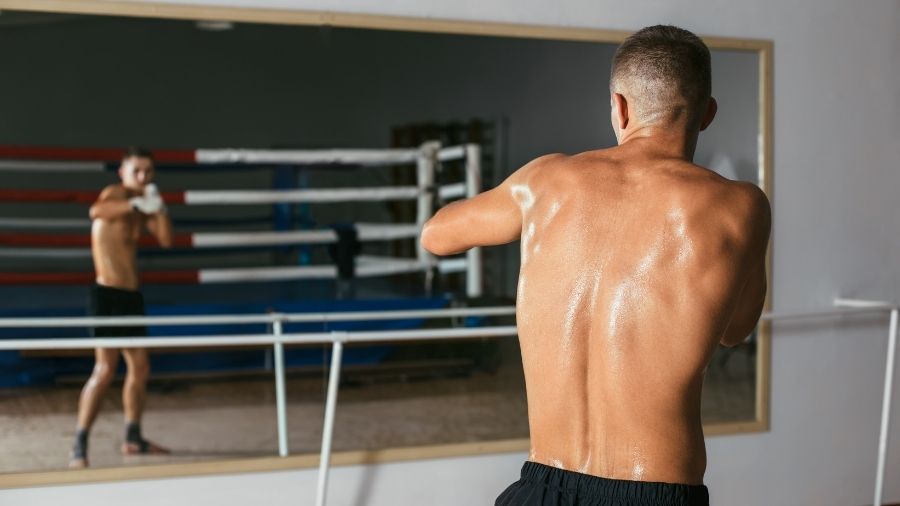
Throwing punches willy nilly does not make for effective shadowboxing. So here are some tips for getting the most out of your shadowboxing.
Mirrors Are Your Friend
The last thing you want to do is ingrain bad habits. Having a mirror can provide visual feedback so you aren’t throwing sloppy punches or not using any head movement.
Have A Watchful Eye
Don’t have a mirror? If you have a training partner or coach, you’ve got the next best thing for monitoring your technique. Subtle cues and feedback from a more experienced boxer can help you to maintain proper technique.
Use Your Imagination
Shadowboxing is not a mindless exercise. Imagine yourself moving around the ring. As your imaginary opponent throws a jab, use your head movement to slip the punch and footwork to position yourself to get a combination of punches off. This visualization will help you bridge the gap between solo shadowboxing to sparring.
Practice New Combinations
Solo drills like shadowboxing are a great time to practice new combinations and new defensive techniques. There is no opponent to worry about. So go slow. Get it right. And start to perform them at speed as you gain more confidence.
Focus On Problem Areas
Is head movement something you struggle with? Then you can focus your shadowboxing session on proper head movement and making it a habit.
Shadowboxing Workout For Beginners
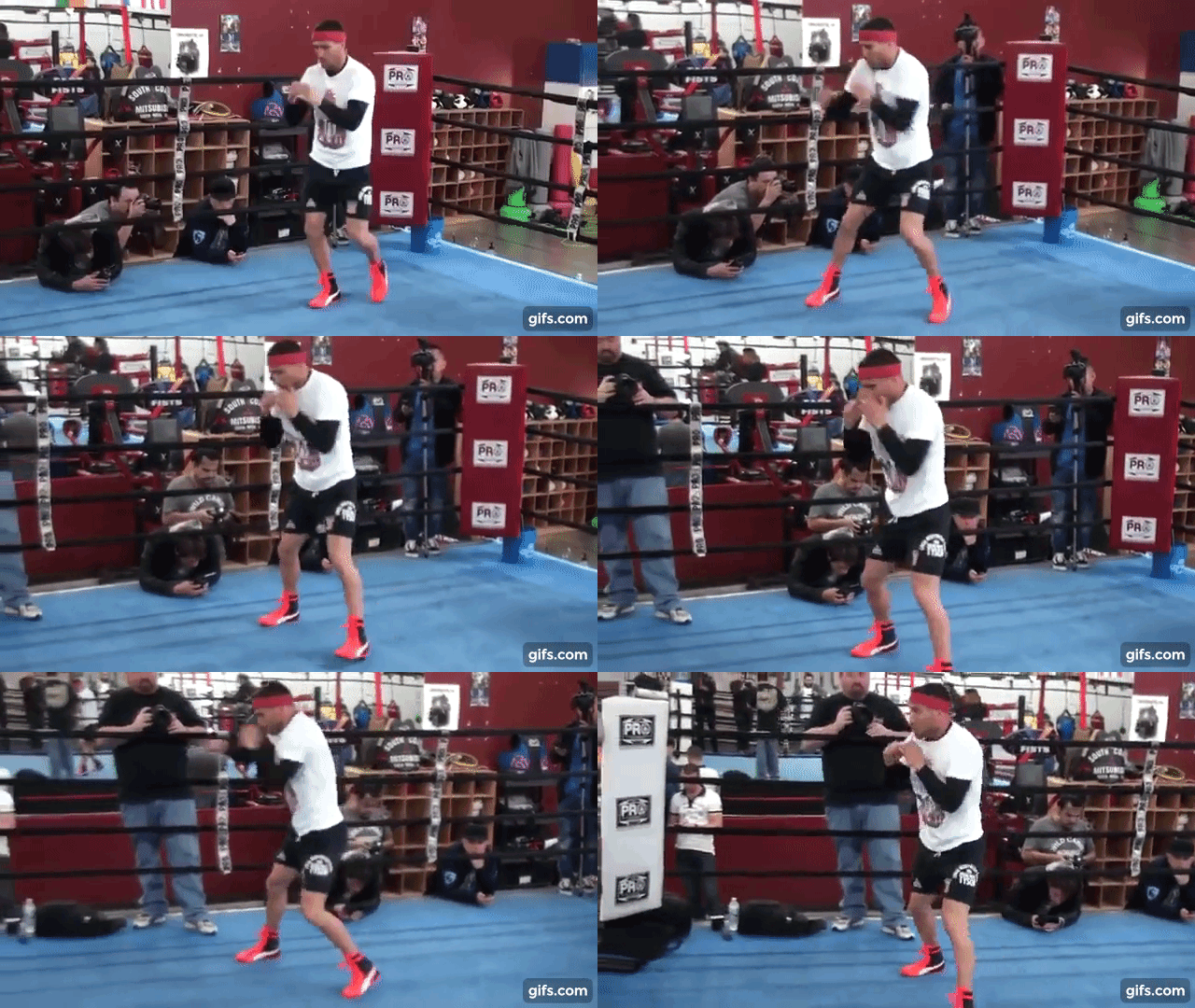
Boxing workouts don’t have to only involve shadowboxing. While prioritizing shadowboxing as part of your workout is a great idea, some variation can give you an even greater stimulus to kick you into boxing shape.
Firstly, here are some basic boxing combinations for beginners:
- •Jab-Cross (1-2)
- •Jab-Jab-Cross (1-1-2)
- •Jab-Cross-Hook (1-2-3)
- •Jab-Hook (1-3)
- •Jab-Cross-Hook-Hook Body (1-2-3-3b)
- •Cross-Jab (2-1)
- •Cross-Hook (2-3)
- •Cross-Hook-Cross (2-3-2)
- •Cross-Hook-Uppercut (2-3-6)
- •Jab-Cross-Hook-Uppercut-Hook (1-2-3-6-3)
Any variation of these combos will give you plenty to work with in your shadowboxing routine. Here are some example shadowboxing workouts you can perform.
Workout Option 1: Aerobic Conditioning Focused (45 min)
| Exercise | Time |
|---|---|
| Shadowbox | 20 minutes |
| Jump rope | 10 minutes |
| Shadowbox | 15 minutes |
Workout Option 2: Aerobic Conditioning Focused (60 min)
| Exercise | Time |
|---|---|
| Shadowbox | 15 minutes |
| Medicine ball throws circuit | 5 minutes |
| Shadowbox | 15 minutes |
| Jump rope | 10 minutes |
| Calisthenics | 5 minutes |
| Shadowbox | 10 minutes |
Workout Option 3: Technique Focused (30 min)
| Exercise | Time |
|---|---|
| Jab only | 5 minutes |
| Focus on defensive footwork and head movement | 5 minutes |
| Various punch and defensive combinations | 20 minutes |
Should You Shadowbox With Weights?
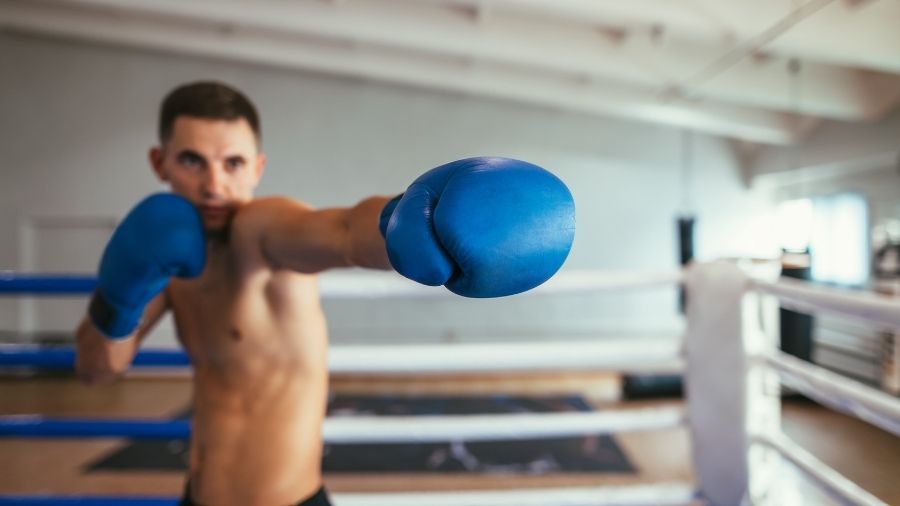
Shadowboxing while holding light dumbbells or using weighted gloves is often dismissed as it changes punching technique and therefore, will negatively affect your technique when boxing. If you are shadowboxing with weights sporadically, this is unlikely to have any real negative effects.
If you are doing it often, that is another story and you are better off cutting the time you spend shadowboxing with weights. My general advice would be to avoid shadowboxing with weights altogether. However, using them every now and again for arm and shoulder endurance purposes could be beneficial but I wouldn’t rely on it.
In no way is shadowboxing with weights going to help you punch harder.
Gravity works vertically. Meaning the line of force isn't in line with your arm. So, holding dumbbells does nothing for enhancing the speed and power of your punch.
You may argue that using bands would be better as the line of pull is the same as the direction of the punch. However, you then change the entire rhythm of the punch and reduce the impact of the double peak muscle activation. An important phenomenon elite strikers display.
What Equipment Do You Need To Shadowbox?
You need absolutely no equipment to shadowbox. That is the beauty of this exercise. However, a mirror would be a great addition if you’re wanting some visual feedback. Further, a jump rope and a light medicine ball can be good additions to add some variety to your shadowboxing workouts.
Is Shadowboxing Good For Losing Weight?
Shadowboxing is a great way to lose weight whether you are a boxer or a general fitness fanatic. Firstly, exercise to lose weight is most effective when it is something you enjoy and can stick to. What makes shadowboxing unique from sitting on a cardio machine is that you are learning a new skill or perfecting a skill you may know.
This is a much greater drive to be physically active than having to spend 60 minutes sitting on a bike. Further, shadowboxing is non-impact. So you aren’t pounding your joints on the road and causing joint pain and problems.
Does Shadowboxing Build Muscle?
You watch the professional boxers on TV, and you see many of them have huge shoulders, arms, and back muscles. Intuitively you may be wondering, “does shadowboxing build muscle?”
Shadowboxing does not build muscle. Building muscle requires maximizing mechanical tension and metabolic stress which are key mechanisms of building muscle. Shadowboxing does neither.
The reason shadowboxing doesn’t build muscle comes down to the key mechanisms of hypertrophy (aka muscle growth or building muscle). These are mechanical tension, metabolic stress, and muscle damage.
Mechanical tension is maximized by force production while the muscle is put through stretch [3]. To maximize force production, heavy loads must be used through a full range of motion. For example, a heavy ass to grass squat.
Mechanical tension can also be maximized with lighter loads when taken to failure as the slowing velocity of the exercise allows more cross-bridges to be formed within the muscle resulting in greater tension.
Metabolic stress is simply the build-up of metabolic by-products that occur as part of creating energy for your muscles to use to contract [4]. This is often associated with the “burn” sensation you get when performing high rep exercises.
Muscle damage is a by-product of these two mechanisms. High levels of mechanical tension and/or metabolic stress can cause a lot of muscle damage which signals the body to repair and create new muscle tissue [3].
Shadowboxing ticks none of these boxes. When you first start shadowboxing, you may experience the “burn” sensation in your shoulders and arms since you are not used to keeping the boxing stance for long periods.
But this subsides quickly and you don’t want this burn as shadowboxing should be relaxed and fluid. If you are finding your arms and shoulders are tiring quickly, you may be too tense.
Shadowboxing however will help develop shoulder and arm endurance that can carry over to your boxing performance.
Does Shadowboxing With Weights Build Muscle?

Shadowboxing with light weights can be an exercise to help develop shoulder and arm endurance when used sparingly. However, it should be a mainstay within your boxing training and definitely should not be used in the guise of making you punch harder.
Just like traditional shadowboxing, shadowboxing with weights will not build muscle. The loads used are not heavy enough to maximize mechanical tension or to get near failure, the muscles of the arm and shoulder are not put under stretch, and because of these factors, there is little metabolic stress.
When holding weights in your hands and shadowboxing, the line of force is vertical due to gravity. That means there is no resistance when punching horizontally.
What Muscles Does Shadowboxing Work?
Shadowboxing will mainly work the muscles of the chest, shoulders, and arms. The muscles of the trunk and the legs will also be worked when shadowboxing. However, just because they are being used when shadowboxing doesn’t mean that you will build muscle in these areas.
Can Shadowboxing Get You Ripped?

Just like any form of exercise, shadowboxing can get you ripped. Getting ripped is a combination of having high levels of muscle mass and low levels of body fat. While shadowboxing won’t help you pack on muscle, it can help shed body fat by expending energy which, depending on your diet, will put you into a caloric deficit.
By expending more energy than you consume (aka calories), you start to lose weight. Depending on how much body fat you are carrying, and depending on if you are lifting weights, most of your weight loss will come from body fat.
However, if you are eating enough to maintain your bodyweight or gain bodyweight, shadowboxing will not get you ripped so it all comes down to your food intake.
Will Shadowboxing Give You Abs?
Shadowboxing can give you abs like it can get you ripped depending on your caloric intake. Shadowboxing can help you get into a caloric deficit so you are losing weight. For your abs to show, you need a very low body fat percentage.
No number of sit-ups and crunches will give you abs if you are holding onto too much body fat. Shadowboxing can be a way to reduce your body fat so your abs show.
Can Shadowboxing Make You Stronger?

Shadowboxing cannot make you stronger. Strength requires performing exercises under heavy loads. Strength is also specific to the task. Shadowboxing doesn’t require you to overcome any form of resistance, even if you are holding weights in your hands.
Because there is no resistance when shadowboxing, it will not get you stronger. If you want to get stronger for boxing, you need to perform basic exercises with barbells, dumbbells, kettlebells, and medicine balls.
Is Shadowboxing Better Than Running?
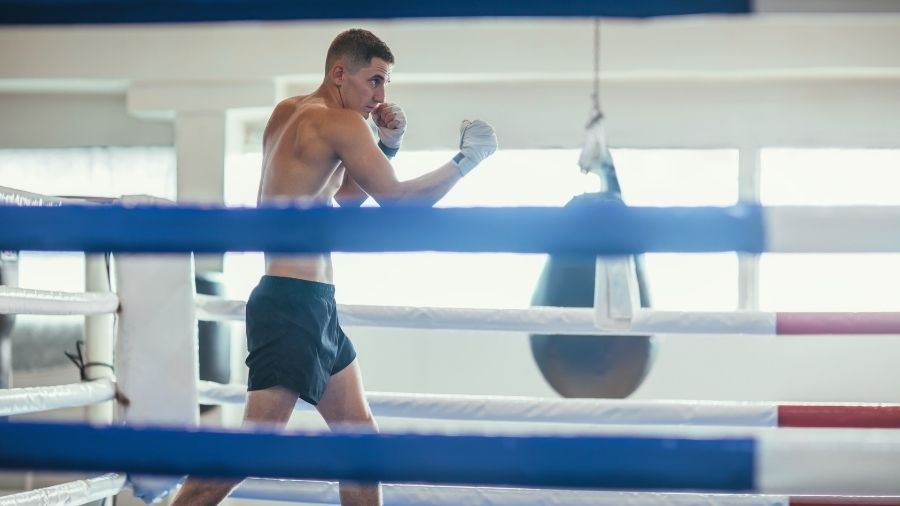
Very rarely would I say one exercise is better than another. Most of the time, it depends on the goal of the exercise. However, for the sport of boxing, I can unequivocally say shadowboxing is better than running for technical and conditioning purposes.
It doesn’t matter how often, far, or fast you run. It will never adequately prepare you for a boxing match. Sure, some roadwork when you have a heavy boxing schedule may be beneficial for some cross-training to break the monotony of throwing punches.
However, for the vast majority of you who aren’t boxing every single day more than once a day, spending time running is a missed opportunity to perfect your boxing skills through shadowboxing. You can get the same conditioning outcomes as a long road run without the impact on your knees and with a better transfer to your boxing.
So where possible, spend your time shadowboxing instead of running.
References
1. Smith, M. S. (2006). Physiological profile of senior and junior England international amateur boxers. Journal of sports science & medicine, 5(CSSI), 74.
2. Bruzas, V., Stasiulis, A., Cepulenas, A., Mockus, P., Statkeviciene, B., & Subacius, V. (2014). Aerobic capacity is correlated with the ranking of boxers. Perceptual and motor skills, 119(1), 50-58.
3. Schoenfeld, B. J. (2010). The mechanisms of muscle hypertrophy and their application to resistance training. The Journal of Strength & Conditioning Research, 24(10), 2857-2872.
4. Schoenfeld, B. J. (2013). Potential mechanisms for a role of metabolic stress in hypertrophic adaptations to resistance training. Sports medicine, 43(3), 179-194.
Get The BJJ Blueprint
Download our free 4-week strength program designed specifically for white and blue belts looking to level up their physicality.
