

Karate Strength Training
Don’t let the common karate view of lifting weights making you slow dissuade you from strength training. When performed correctly, strength training is only going to make you faster and enhance your karate performance.
Strength training for karate should focus on speed and explosive style training as they differentiate winners and losers in Karate Kumite. However, maximal strength predicts over 50% of punch acceleration in karateka meaning strength may also have an important role.
If we are to perform strength training to enhance karate performance, we must understand what differentiates elite and non-elite karateka, and what differentiates winning and losing performances.
Further, it’s important to understand the common injuries that occur in karate to perform exercises to reduce the risk of injury.
Common Injuries In Karate Kumite
A survey of 204 karatekas in Dehli, India who were aspiring national and international level karatekas were found to have the most common injuries to the head and face [1]. 57% of injuries were sudden while 36% were gradual onset injuries.
These mostly occurred from direct contact from punches and kicks (65%) while 35% were non-contact related injuries.
At the higher level of World Karate Championships (WKC), 2,837 matches were analyzed over three tournaments [2].
Supporting the previously mentioned study, the majority of injuries were to the face (72%) and head (12%). The neck (4%) and upper arms (3%) were the next most injured sites.
Most of these injuries were bruises (50%), blood nose (16%), and cuts (14%), followed by concussions (4%) and sprains (3.5%).
Punches caused the greatest number of injuries at 83% while kicks caused 7%. This is likely due to punches being thrown 10 times more than kicks during Kumite [2].
Karate very rarely results in severe injury, and in this study only 3% of all injuries were severe. 89% were considered minor injuries.
The number of injuries in this study were considered high and is likely due to the level of competition. Research has demonstrated that the higher the rank, the greater number of injuries that occur [3].
Further, the lower the weight class, the higher number of injury incidences [3][4].
Regarding when injuries occur, most happened during fight practice (90%) to the head and neck [5].
Overall, many of these injuries aren’t preventable. However, due to the amount of head damage, strengthening of the neck to reduce the risk of concussion is a preventative measure that should be taken.
Strength Profile Of Elite vs. Non-Elite Karateka
If I was to sum up all of the evidence in one sentence, it would be this.
Karate performance is highly influenced by speed and explosivity and not by so much by maximal strength.
Here is how I have come to that conclusion. 22 international and national level karateka were compared regarding force, velocity, and power metrics [6].
They found that international karateka had greater velocity and power scores by 13-14% compared to national level karateka.
Further, they were able to squat jump (pause during the dip so no elastic energy is used) 14% higher than the national level karateka.
What was not different between the groups were their force metrics indicating speed and power are what distinguish between high and lower-level karateka.
Contrary to this study, when 7 highly competitive black belts were compared to 9 novice white belts, the black belts displayed a significantly greater bench press and half squat 1RM [7]. Why are these findings so different?
It could be the exercise used to test. But in my opinion, it comes down to the vast difference in karate experience level. The black belts had on average 12-13 years of karate experience whereas the white belts had on average 1 year.
12 extra years of karate training means 12 extra years of plyometric and explosive (jumping, punching, kicking) exercise that occurs during karate technical training and sparring.
Both plyometric and jump training have been shown to improve strength without the use of weight training [8][9].
Where this becomes interesting is when comparing winners and losers in Karate Kumite. When differentiating international level black belt winners and losers, maximal strength was not different between the two [10].
Rather, peak power generated during a squat and bench press with 30% 1RM is what differentiated the two groups.
It seems, in agreement with the first study mentioned, that power output is a more important component of karate performance than maximal strength.
Another interesting study compared 6 elite, international karateka and 6 amateur karatekas who were put through isokinetic strength testing of the quads and hamstrings and testing of the front kick [11].
To explain isokinetic testing in layman’s terms, it involves being strapped into a chair similar to a seated leg extension and leg curl machine. The pad rests above and below the ankle and the movement is exactly the same as performing a leg extension or leg curl.
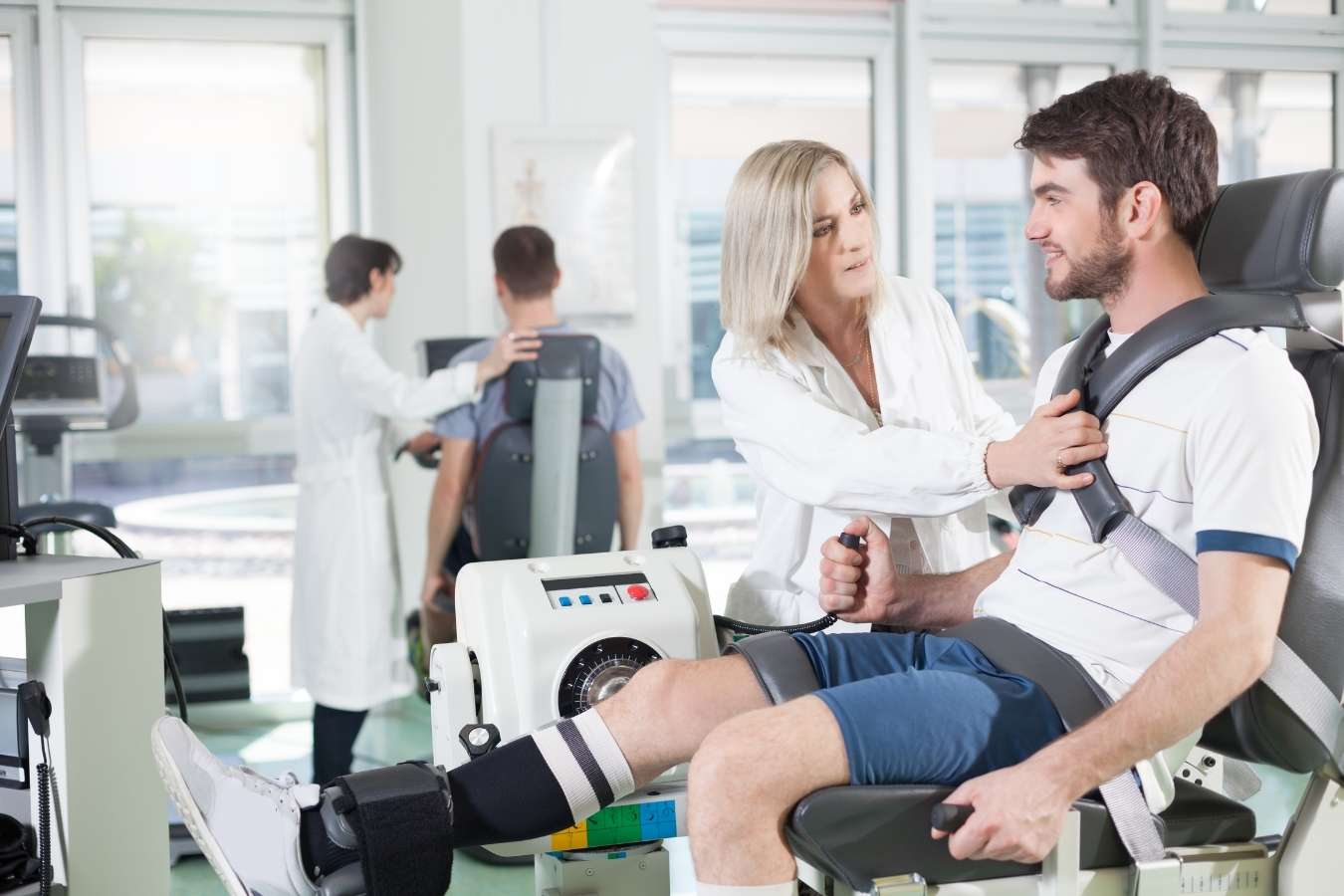
Isokinetic Dynamometer
However, the computerized machine will set the movement of the pad at a certain speed and it. The individual will leg extension or leg curl as hard as possible against this constant speed of movement and force will be measured.
It gives an indication of the ability to produce or resist force (or torque as force is angular in this instance) at fast and slow speeds.
When comparing the international to amateur karateka, no difference was found in knee extension force (quads). But there were greater values for knee flexion (hamstrings) force at all speeds compared to amateurs.
International level karateka also had reduced antagonist (opposite to the muscle performing the work) activation at all velocities compared to amateurs.
This is conducive to increased speed as having a high activation of both agonist and antagonist is a protective mechanism that reduces speed.
This was backed up by the free-kick data where the international karatekas were faster at bringing the knee up and straightening the knee during the kick than amateurs.
What is interesting is that the biceps femoris (one of the hamstring muscles) was active during the whole knee straightening phase of the kick which is likely an adaptation imposed from the international rules where you can’t cause damage with a kick.
The increased activity of the biceps femoris is to apply intense braking forces to slow the limb down at impact. This means high levels of eccentric force capabilities are needed.
Conversely, amateur karateka did not show this phenomenon likely due to skill and strength deficiencies.
Finally, when comparing different styles of karateka, offensive and defensive, offensive fighters displayed greater vertical jump capabilities compared to defensive style fighters [6].
This is likely due to offensive style fighters needing to be explosive and fast in order to effectively land their attacks.
Overall, we can summarise these findings as needing to develop high levels of velocity and power along with eccentric hamstring strength at high velocities.
Strength Profile Of Elite Karateka
Research in this area is scarce. What we know from the data we have is karatekas display relatively good explosive power ranging from around 42-50 cm in height [13].
This jump height is heavily influenced by body fat percentage and fat-free mass meaning the leaner more muscular you are, the higher you will jump [14].
Regarding 1RM strength, elite karateka standards are around a 137 kg squat and an 87 kg bench press. Nothing to write home about but as we know, maximal strength may not have such a great influence on karate performance.
Strength Training For Karate Kumite
While this section focuses on Kumite, many of these same principles can be applied to training for karate kata as both require high levels of speed and power.
I mentioned previously that maximal strength potentially isn’t important for karate performance as it does not differentiate between winners and losers.
However, 56-65% of punch acceleration in elite karateka can be explained by average power in the jump squat relative to body weight, and either squat or bench press 1RM [12].
Similar findings have been found in the boxing population which you can read about here.
For that reason, some form of maximal strength should take place in a karate training program. Just not with a great emphasis.
Both plyometric and cluster set configurations have been shown to improve explosive power and maximal strength in karateka so these example programs will have a thread of these elements [15].
These will be in two phases. Phase 1 will be preparation for more intense plyometric and jump exercises along with “slower” strength exercises.
Phase 2 will be more specific to karate with more intense plyometrics and jumps and “faster” strength exercises. Strength training will occur two days a week to allow for adequate karate training.
Phase 1
Day 1
| Exercise | Set/rep | load | |
|---|---|---|---|
| A1) Extensive Box Rebound | 3x10 | ||
| B1) Multi-Directional Single-Leg Pogo | 3x20 | ||
| C1) Extensive Rolling Hop | 3x10 | ||
| D1) Extensive Medicine Ball Chest Pass Rebound | 3x20 | ||
| E1) Back Squat | 3x2+2+2 | ||
| E2) Nordic Drop | 3x5 | 3x5 | |
| 3x5 | |||
| F1) Bench Press | 3x2+2+2 | @70-80% 1RM | |
| F2) Chin-Up | 3x5-10 | ||
| G1) Neck Variation |
Day 2
| Exercise | Set/rep | load | |
|---|---|---|---|
| Plyo/Jump Circuit | |||
| A1) Squat Jump | 1x10 | ||
| A2) Double Leg Pogo | 1x10 | ||
| A3) Rotational Squat Jump | 1x10 | ||
| A4) Forwards Pogo | 1x10 | ||
| A5) Lateral Jump Squat | 1x10 | 1x10 | |
| 1x10 | |||
| A6) Backwards Pogo | 1x10 | ||
| B1) Incline Extensive Explosive Push-Up | 3x8-10 | 3x8-10 | |
| 3x8-10 | |||
| C1) Speed Squat | 6x2 | @30-40% 1RM | |
| D1) Romanian Deadlift | 4x6-8 | @70-80% 1RM | |
| E1) DB Incline Bench | 3x6-10 | ||
| E2) DB Row | 3x6-10 | ||
| F1) Neck Variation |
Phase 2
Day 1
| Exercise | Set/rep | load | |
|---|---|---|---|
| A1) Low Drop Jump Into Kick Technique | 4-5x2-3 | ||
| B1) Medicine Ball “Punch” Throw | 3-4x3-4 | ||
| C1) Jump Squat | 3x2+2+2 | @30-40% 1RM | |
| D1) Single Leg Drop Catch Back Extension | 3x5 | ||
| E1) Bench Press | 3x1+1+1 | @80-90% 1RM | |
| E2) Nordic Drop | 3x5 | 3x5 | |
| 3x5 | |||
| F1) Chin-Up | 3x5-10 | ||
| F2) Neck Variation |
Day 2
| Exercise | Set/rep | load | |
|---|---|---|---|
| A1) Bench Throw | 3x2+2+2 | @30-40% 1RM | |
| B1) Back Squat | 3x1+1+1 | @80-90% 1RM | |
| B2) Band Assisted Jump Squat | 3x3-5 | ||
| C1) 2up, 1down Lying Leg Curl | 3x5-6/leg | ||
| C2) DB Row | 3x6-10 | ||
| D1) Neck Variation | 3x5 | 3x5 | |
| 3x5 | |||
| F1) Chin-Up | 3x5-10 | ||
| F2) Neck Variation |
References
1. PAL, S., YADAV, J., KALRA, S., & SINDHU, B. (2020). Prevalence of Injury Pattern among Karate Players in Delhi-National Capital Region-A Cross-sectional Survey. Journal of Clinical & Diagnostic Research, 14(8).
2. Arriaza, R., & Leyes, M. (2005). Injury profile in competitive karate: prospective analysis of three consecutive World Karate Championships. Knee Surgery, Sports Traumatology, Arthroscopy, 13(7), 603-607.
3. Zetaruk, M. N., Zurakowski, D., Violan, M. A., & Micheli, L. J. (2000). Safety recommendations in Shotokan karate. Clinical Journal of Sport Medicine, 10(2), 117-122.
4. PAL, S. (2020). Preventive Methods for Karate Injuries-A Review. Journal of Clinical & Diagnostic Research, 14(10).
5. Ziaee, V., Shobbar, M., Lotfian, S., & Ahmadinejad, M. (2015). Sport injuries of karate during training: an epidemiologic study in Iran. Asian journal of sports medicine, 6(2).
6. Ravier, G., Grappe, F., & Rouillon, J. D. (2004). Application of force-velocity cycle ergometer test and vertical jump tests in the functional assessment of karate competitor. J Sports Med Phys Fitness, 44(4), 349-55.
7. Imamura, H., Yoshimura, Y., Uchida, K., Nishimura, S., & Nakazawa, A. T. (1998). Maximal oxygen uptake, body composition and strength of highly competitive and novice karate practitioners. Applied Human Science, 17(5), 215-218.
8. Brown, A. C., Wells, T. J., Schade, M. L., Smith, D. L., & Fehling, P. C. (2007). Effects of plyometric training versus traditional weight training on strength, power, and aesthetic jumping ability in female collegiate dancers. Journal of dance medicine & science, 11(2), 38-44.
9. Bogdanis, G. C., Tsoukos, A., Kaloheri, O., Terzis, G., Veligekas, P., & Brown, L. E. (2019). Comparison between unilateral and bilateral plyometric training on single-and double-leg jumping performance and strength. The Journal of Strength & Conditioning Research, 33(3), 633-640.
10. Roschel, H., Batista, M., Monteiro, R., Bertuzzi, R. C., Barroso, R., Loturco, I., … & Franchini, E. (2009). Association between neuromuscular tests and kumite performance on the Brazilian Karate National Team. Journal of sports science & medicine, 8(CSSI3), 20.
11. Sbriccoli, P., Camomilla, V., Di Mario, A., Quinzi, F., Figura, F., & Felici, F. (2010). Neuromuscular control adaptations in elite athletes: the case of top level karateka. European journal of applied physiology, 108(6), 1269-1280.
12. Loturco, I., Artioli, G. G., Kobal, R., Gil, S., & Franchini, E. (2014). Predicting punching acceleration from selected strength and power variables in elite karate athletes: a multiple regression analysis. The Journal of Strength & Conditioning Research, 28(7), 1826-1832.
13. Chaabene, H., Hachana, Y., Franchini, E., Mkaouer, B., & Chamari, K. (2012). Physical and physiological profile of elite karate athletes. Sports medicine, 42(10), 829-843.
14. Spigolon, D., Hartz, C. S., Junqueira, C. M., Ariel, R., & Vitor, F. H. (2018). The correlation of anthropometric variables and jump power performance in elite karate athletes. J Exerc Physiol.
15. Aminaei, M., Yazdani, S., & Amirseifadini, M. (2017). Effects of plyometric and cluster resistance training on explosive power and maximum strength in karate players. International Journal of Applied Exercise Physiology, 6(2), 34-44.
Karate Conditioning
Many fell in love with karate because of movies such as the Karate Kid. I’m also sure Bruce Lee was a big influence as well even though he wasn’t showcasing karate, but rather kung fu, in his movies.
Karate hasn’t been studied or covered as extensively as other martial arts and therefore, training information tends to be scarce when looking for quality training information.
Conditioning for the demands of karate is very similar when training for kumite or kata. Both disciplines require short explosive bursts of energy interspersed with footwork, bouncing, or complete break. A highly developed alactic and aerobic energy system is needed to excel in karate.
Let’s break down the demands imposed on a karateka during kumite and kata. Are they any different?
Match Demands Of Karate Kumite
When developing a conditioning plan for karate kumite, we first must understand the demands of a competitive match. And to some extent, the demands of simulated matches.
Research is scarce in this area as karate isn’t a widely researched topic. However, we do have some data to go by in high-level National and International karatekas.
In an older study in 2004, nationally and internationally ranked karateka performed two to four simulated fights of 60 seconds [1]. They found an activity to break ratio of 2:1 with 12-24 seconds of activity and 3-15 seconds of break phases.
These activity periods consisted of 1-3 seconds of high-intensity activity (attack and defense) for a total of 1-5 high-intensity actions per minute.
Based on oxygen uptake measurements after each fight, the study concluded Karate Kumite is dominated by the aerobic energy system. Activities such as forward, backward, sidesteps, and hopping movements combined with short high-intensity bursts of attacking strikes cause a metabolic profile highly aerobic which is supplemented by anaerobic energy production.
Competitive matches may tell a different story. Elite karatekas were studied during the 2012 senior World Championships [2].
Only bronze medal and final matches were analyzed with video which was 4 minutes in length for males and 3 minutes for females. The study found a completely different activity to break ratio of 1:1.5.
This was broken down into 6.5-11 seconds of activity and 5.5-17 seconds of break phase.
This represented 15% and 13% of total fight time respectively. The remaining fight time was made up of preparatory activity (bouncing, footwork, feints).
When broken down by weight class, light weights kept a 1:1.5 activity to break ratio while middleweights had a 1:2 and heavyweights had a 1:1 activity to break ratio.
High-intensity actions were similar to the previous study with each action lasting 1-3 seconds. This led to a 1:8 high-intensity action to break ratio when taking into account the 6.5-11 second activity period with a total of 24-40 high-intensity actions per fight.
To top it off, top-level karatekas used more upper limb techniques than lower limb techniques.
This discrepancy between simulated and competitive matches was further confirmed in a 2014 study [3]. They directly compared black belt national and international level karatekas when participating in ten competitive and ten simulated matches.
They found upper limb techniques were used twice as much in competition compared to simulated matches. Preparatory and fighting activity times were higher during simulated matches, while break time was longer during competitive matches.
Competitive matches had a much longer high-intensity effort to pause ratio of 1:11 compared to 1:7 during simulated matches. High-intensity actions lasted up to 5 seconds in this study. Blood lactate was higher during competitive matches but is low overall indicating little involvement of the anaerobic lactic energy system.
To sum this data up, we can say the activity to break ratio ranges from 1:1 to 1:2 depending on the weight class. Further, high-intensity activities range from 1-5 seconds within a 6-11 second activity period. The pause period of 5-17 seconds.
Overall, karate kumite is characterized by short high-intensity actions mainly maintained through the alactic energy system interspersed with lower intensity karate specific movements and breaks maintained by the aerobic energy system.
Competitive Demands Of Karate Kata
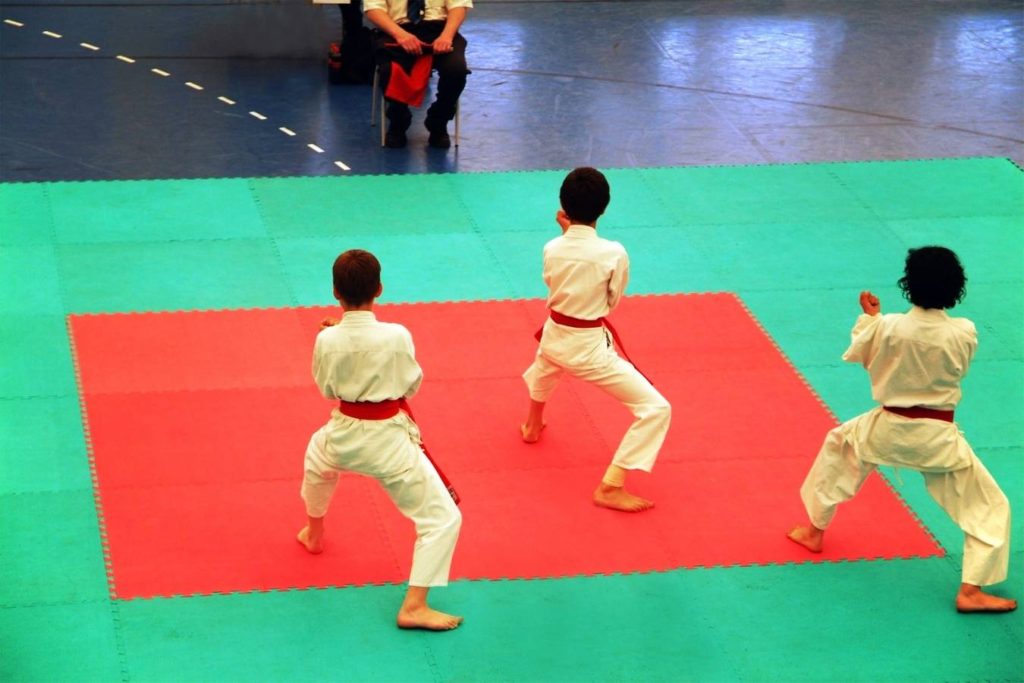
Karate also has a non-combative discipline named kata. It’s important to note before taking conclusions away from this section, that kata has so many variations from the number of techniques, duration of the kata, level of kata, and style of kata.
That means the competitive demands presented in this section will be based on general trends from kata of multiple styles.
One of the first studies investigating the demands of kata was in 1982 [4]. They had karatekas perform a Shotokan style kata with 24 movements under continuous or interval conditions. The continuous condition involved performing each movement for 30 or 45 seconds in a continuous fashion.
The interval condition involved the same rep speed but karatekas had a 60-second rest between each movement. They found that performing 30 second continuous kata was the best protocol for developing the aerobic energy system with VO2 (aerobic capacity or oxygen consumption) being greater than 50% of maximum aerobic capacity.
A 1993 study showed, when performing a Shito-Ryu style, 67 movement kata in normal time (approximately 1 minute), oxygen consumption was even greater than the 1982 study at approximately 75% of maximum aerobic capacity [5].
More complex kata seems to demand greater contributions from the aerobic energy system.
Performing kata in this continuous fashion as presented in these two studies would be considered abnormal to competition as kata generally have several short pauses between varying numbers of movements.
However, it seems performing kata in a continuous fashion provides a strong aerobic training stimulus that can influence conditioning training for karate kata.
On the opposite end of the spectrum, a 1995 study investigated a 20 second, 21 technique wado ryu style kata [6]. They had six different conditions;
- •Half of the kata (10 sec)
- •Full kata (20 sec)
- •One and a half kata (30 sec)
- •Two kata (40 sec)
- •Three kata (60 sec)
- •Four kata (80 sec)
They found the anaerobic lactic energy system had a negligible contribution to the half and full kata and increased to have a 13% contribution to the 80 sec kata. Aerobic contribution raised from 11% to 41%.
The major energy system involved was the alactic energy system contributing a whopping 90% of energy during the shortest kata and 46% for the longest.
A more recent 2012 study agrees with these findings concluding that the alactic energy system plays a major role in karate kata [7].
Taking all of this into account, the research suggests that the duration of the kata is what dictates the energy system contributions. Further, the majority of energy is provided by the alactic energy system and as duration increases, so does the involvement of the aerobic energy system [8].
Conditioning For Karate Kumite and Kata
I’m going to place conditioning for both kumite and kata under the same section as I know many karateka train both kumite and kata. Based on the research presented above, both kumite and kata are highly dominated by the alactic and aerobic energy systems.
Aerobic Capacity For Karate
As the aerobic energy system is going to influence recovery between fights, kata, and explosive efforts, karateka must place a great deal of emphasis on aerobic training. Ideally, this should be done through performing karate specific movements.
There is no need to perform traditional aerobic activities such as running, biking, or swimming when more time can be spend rehearsing kata or improving striking skills and footwork.
Kumite
Continuous shadowboxing, pads, or bag work: 20-60 minutes at a heart rate between 130-150 BPM.
Aerobic power: 3 x 3-minute increasing intensity shadowboxing or bag work. Every 30 seconds increase intensity until at 90-95% for the last 30 seconds. Perform easy footwork during the rest period.
Specific karate rounds: 1-3 seconds blitz attack, 6-11 seconds of total activity. Break period depending on weight class.
Kata
Manipulation of kata practice by either performing each movement slowly in a continuous fashion or longer kata performed at normal speed with approximately 1:1 work to rest ratio.
Anecdotally, six-time karate World Champion Mona Pretorius performed no other external conditioning training during her karate success. Everything was performed on the mats by varying the intensity of the kata being practiced.
For example, perform 8-9 kata at 60-80% effort and the final one or two kata at 100% effort.
Heart rate may not be a great indicator during kata due to the isometric tension produced during movements so best to go by feel and how heavy you are breathing.
Alactic Power & Capacity For Karate
As we know from “What Is Conditioning Training,” the alactic system is the least trainable energy system and is highly genetic. However, that doesn’t stop us from improving our ability to perform explosive efforts.
Kumite
Taking our alactic power guidelines, performing 7-10 seconds of all-out strikes against pads or bags with full recovery is how you can develop power striking.
However, alactic power should be supplemented off the mat with various jumps, throws, and plyometrics. For example, maximal medicine ball throws for height, jumps for maximal height or distance, plyometric exercise with the intent of jumping as high as possible with the least amount of time spent on the ground.
Alactic capacity can be trained in exactly the same manner but with 10-15 seconds of work with only 20-90 seconds of rest. For example, split squat jumps for 15 seconds with 30 seconds of rest.
Kata
Alactic power and capacity for kata will have to be trained exclusively off the mat. That is the one key difference between kumite and kata.
While some kata has various jumps as part of the movement sequence, just performing the kata likely won’t develop the maximal outputs.
As with alactic power and capacity training for kumite, training for kata should involve mainly jumping and plyometric exercises. For example, 3 x 10 hurdle hops with incomplete recovery. Or squat jump with 30-40% of 1RM for 3 x 3-5 with full recovery.
Don’t forget to take your creatine monohydrate to increase your alactic capacity without any training!
Anaerobic Lactic Capacity and Power For Karate
Both karate kumite and kata have minimal contributions from the anaerobic lactic energy system. Having a well-developed aerobic energy system that can be called upon to supply more energy as a competition day goes on or kata gets longer, and an alactic energy system with a large supply of ATP and the ability to replenish it quickly will likely optimize karate performance.
This suggests lactic training needn’t even feature in your training program. However, this doesn’t mean you shouldn’t train for the worst-case scenario that could occur during kumite.
Worst Case Scenario For Kumite
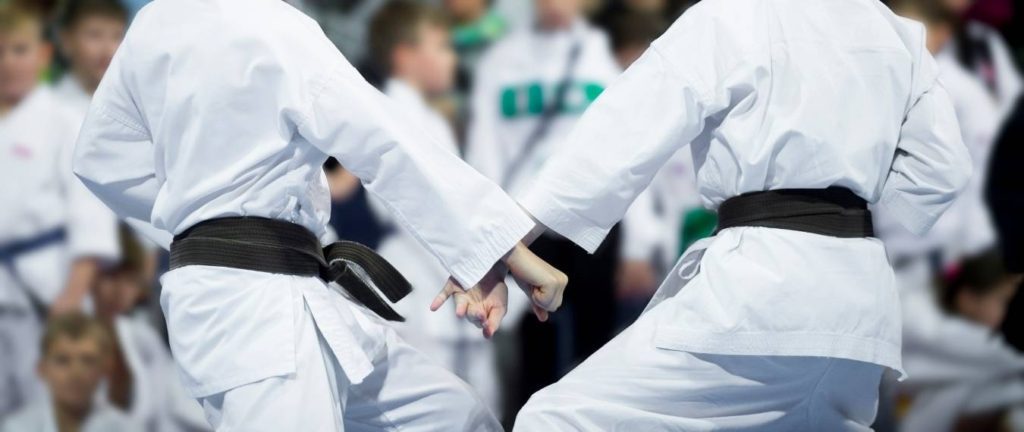
When training for worst-case scenario, it’s best done with a training partner as an opponent in a sparring format. This could potentially be done as bag work or against pads.
Importantly, just having two karateka spar in a simulated match seems to create activity periods much longer than competition.
Worst case scenario training is great as you can manipulate training variables of the sport to fully prepare the athlete for the worst that could happen within a competitive match.
A worst-case scenario based on the above research for karate kumite would be 11 seconds of activity broken down into 5 seconds of high-intensity attack or defense with 6 seconds of feints, footwork, or bouncing (preparatory phase) and 5 seconds of break.
Repeat this for the fight duration which would be approximately 8 rounds for a two-minute kumite. For example:
Round 1
- •6 seconds preparatory phase
- •5 seconds attack/defense
- •5 seconds break
Round 2
- •3 seconds preparatory phase
- •5 seconds attack/defense
- •3 seconds preparatory phase
- •5 seconds break
Round 3
- •5 seconds attack/defense
- •6 seconds preparatory phase
- •5 seconds break
Round 4
- •2 seconds attack/defense
- •3 seconds preparatory phase
- •2 seconds attack/defense
- •3 seconds preparatory phase
- •5 seconds break
This can be repeated in any random order. The activity to break ratio in this scenario is 2:1 which is similar to the simulated match demands but with competitive match demand activity phase duration.
To increase the number of high-intensity actions, multiple can be performed within one round as shown in round 4. In black belt level matches, 24-40 high-intensity actions are seen in 3-4 minutes so for a two-minute match, aim for a minimum of 12 high-intensity actions.
As stated in some of my previous conditioning articles, break down your own matches or previous matches in your competition and see if you can identify any trends regarding activity to break ratios. They may be slightly different from what is presented here so you can make small adjustments specific to you.
References
1. Beneke, R., Beyer, T., Jachner, C., Erasmus, J., & Hütler, M. (2004). Energetics of karate kumite. European journal of applied physiology, 92(4-5), 518-523.
2. Tabben, M., Coquart, J., Chaabène, H., Franchini, E., Ghoul, N., & Tourny, C. (2015). Time-motion, tactical and technical analysis in top-level karatekas according to gender, match outcome and weight categories. Journal of sports sciences, 33(8), 841-849.
3. Chaabène, H., Mkaouer, B., Franchini, E., Souissi, N., Selmi, M. A., Nagra, Y., & Chamari, K. (2014). Physiological responses and performance analysis difference between official and simulated karate combat conditions. Asian journal of sports medicine, 5(1), 21.
4. Shaw, D. K., DK, S., & DT, D. (1982). Heart rate and oxygen uptake response to performance of karate kata.
5. Zehr, E. P., & Sale, D. G. (1993). Oxygen uptake, heartrate and blood lactate responses to the Chito-Ryu Seisan kata in skilled karate practitioners. International Journal of Sports Medicine, 14(05), 269-274.
6. Francescato, M. P., Talon, T., & Di Prampero, P. E. (1995). Energy cost and energy sources in karate. European journal of applied physiology and occupational physiology, 71(4), 355-361.
7. Bussweiler, J., & Hartmann, U. (2012). Energetics of basic karate kata. European journal of applied physiology, 112(12), 3991-3996.
8. Chaabene, H., Franchini, E., Sterkowicz, S., Tabben, M., Hachana, Y., & Chamari, K. (2015). Physiological responses to karate specific activities. Science & Sports, 30(4), 179-187.
Follow a Full Year's Strength & Conditioning
Get access to complete karate-specific training programs, periodized for athletes at every level.
Start Free Trial